Quick summary
- The Norled Sognefjord express boat runs one sailing a day each way from April to October, 08:00 from Bergen and 15:30 from Flam [1].
- Adult one way fares start from 1,295 NOK, children 6 to 17 and seniors 67 and over from 648 NOK, students 18 to 29 from 777 NOK, under 6 free [1].
- The Bergen: Viking Village, Nærøyfjord Cruise & Flåm Railway already carries a Nærøyfjord cruise ticket in the price, so the water is not an extra.
- The train via Myrdal takes about 2h48 to 4h30 with roughly four departures a day, and advance Lowfare seats are tied to one departure [2].
- Norled express boat From 1,295 NOK adult one way Time5.5 hours one way [1]SailingsOne a day each way [1]SeasonApril to October [1]DepartsStrandkaiterminalen, 08:00 [1]Fjord timeThe whole crossingTicket termsStandard operator fare [1]GuideNone See this tour
- Top choice Viking Village day Price shown on the booking page TimeFull day with fjord cruise and railwaySailingsCheck availability for starting timesSeasonRuns on scheduled operating daysDepartsBergen, meeting details on bookingFjord timeNærøyfjord cruise includedTicket termsFree cancellation, reserve now and pay laterGuideLive guide in English and Spanish Check availability
- Train via Myrdal From 779 NOK one way Time2h48 to 4h30 [2]SailingsAbout 4 a day [2]SeasonYear roundDepartsBergen stationFjord timeOnly near FlamTicket termsLowfare fixed, no refund [2]GuideNone See this tour

Now that new provisions have been adopted, it is important to highlight that they provide the clarity the industry has long awaited.
Which fjord day is actually yours
Included in the tour
- Coach travel for the land legs
- Nærøyfjord cruise ticket already in the price
- Stop at Tvindefossen waterfall
- Viking Village visit
- Live guide in English and Spanish
- Free cancellation, full refund
Good to know
- Reserve now and pay later
- Check availability for starting times
- Flåm Railway journey included
- Viking Village visit included
- Nærøyfjord cruise included
What the water gives you that the road cannot
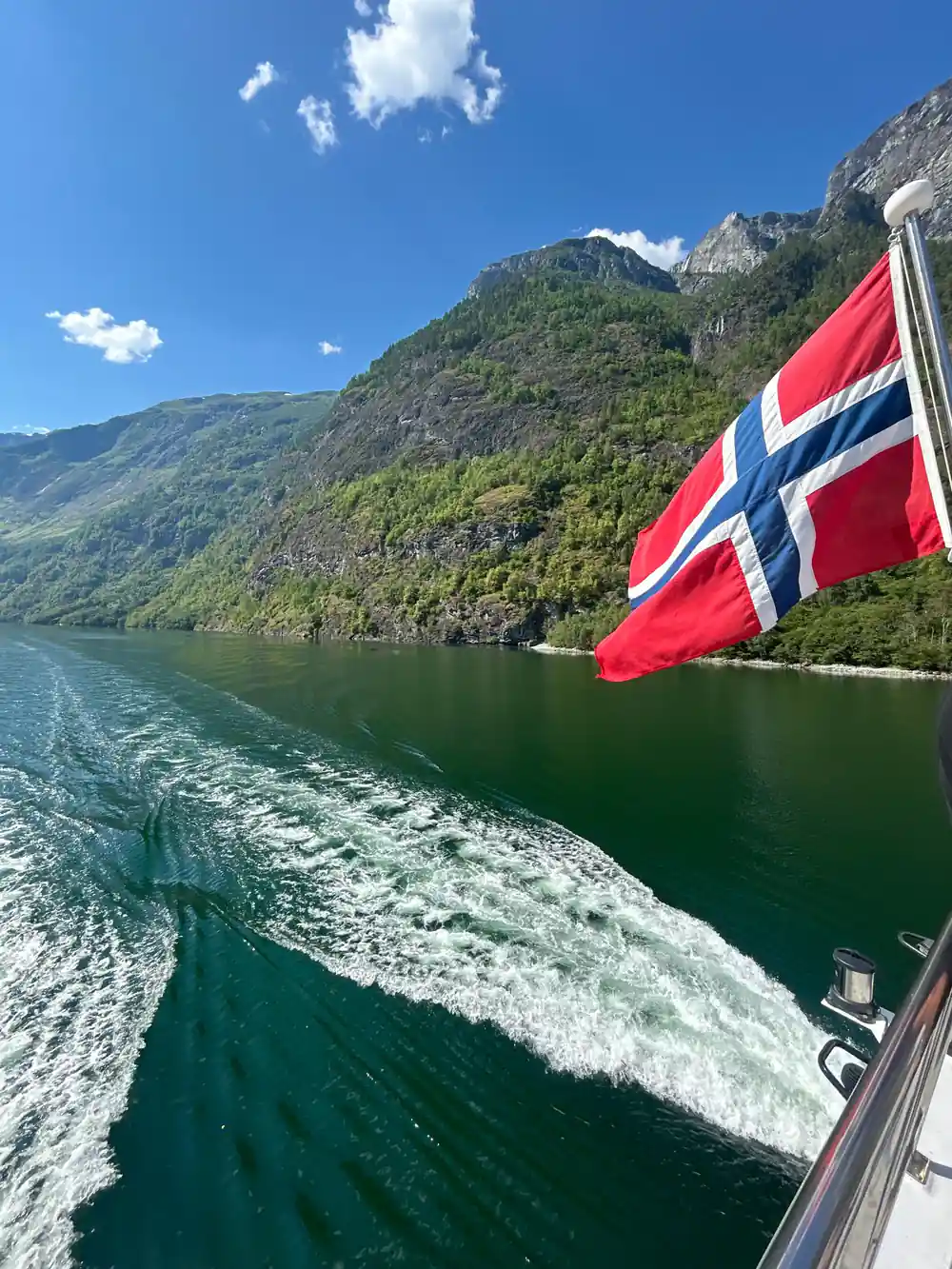
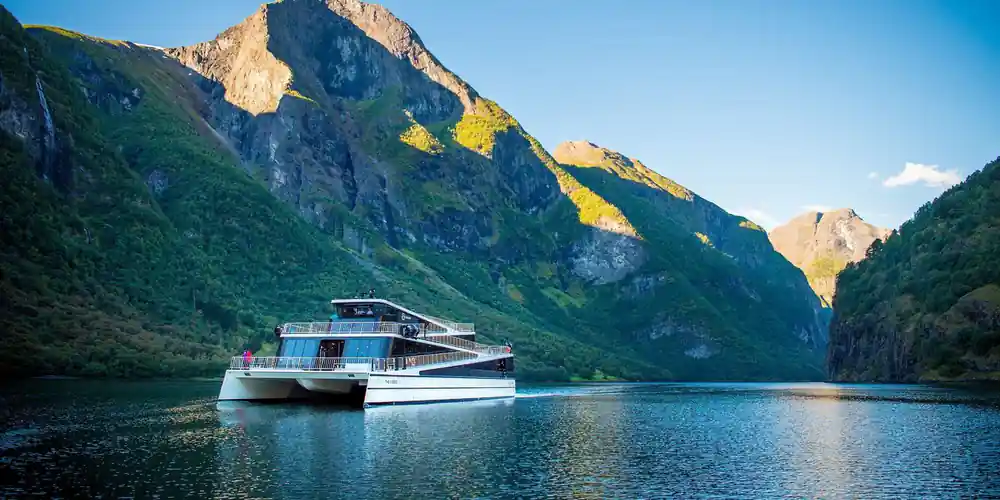
A bus follows the shore. A train runs above it. The boat is the only way to put the fjord underneath you, and on the Sognefjord stretch that changes the scale completely. From the deck the walls rise without a guardrail in front of them, the side valleys open straight down to the waterline, and the small settlements that look like dots from the E16 turn out to have jetties, orchards and a school. You are moving at water speed, roughly the pace the place was built for.
The other thing the water gives you is the narrow section. Where the road has to climb away from the shore to get around the steep ground, the boat stays in the channel. That is the part people photograph. A bergen to flam boat cruise puts you inside the landscape rather than at the edge of a picture of it, and you notice how much of the route the road simply cannot reach.
There is also the practical trade. The boat is slower than driving, about 5.5 hours one way from Bergen to Flam [1], but it is 5.5 hours of scenery rather than 5.5 hours of driving, tunnels and laybys. If you are going to spend the time anyway, spending it on the water is the version you will remember.
The Norled express boat: fares and who pays what
Norled runs the Sognefjord express boat between Bergen and Flam, and the fare structure is refreshingly simple. Adults pay from 1,295 NOK one way [1]. Children aged 6 to 17 pay from 648 NOK, seniors aged 67 and over pay from 648 NOK, and students aged 18 to 29 pay from 777 NOK [1]. Children under 6 travel free [1]. Every figure is a starting fare, not a quote, and the currency here is Norwegian kroner because you are buying from a Norwegian operator.
That is the boat as a standalone transport option. It is not a sightseeing loop from a city pier; it is a working express service on a long fjord, and it is priced accordingly. What you get for it is 5.5 hours one way [1] with the whole Sognefjord and its arms in front of you, arriving at Flam harbour rather than at a station up the valley.
If you are weighing a Norled bergen to flam cruise against the train, the honest comparison is not just money. The rail route is faster and can be cheaper booked early, but it runs inland from Bergen and only joins the fjord near the end. The boat is the fjord for the entire crossing.
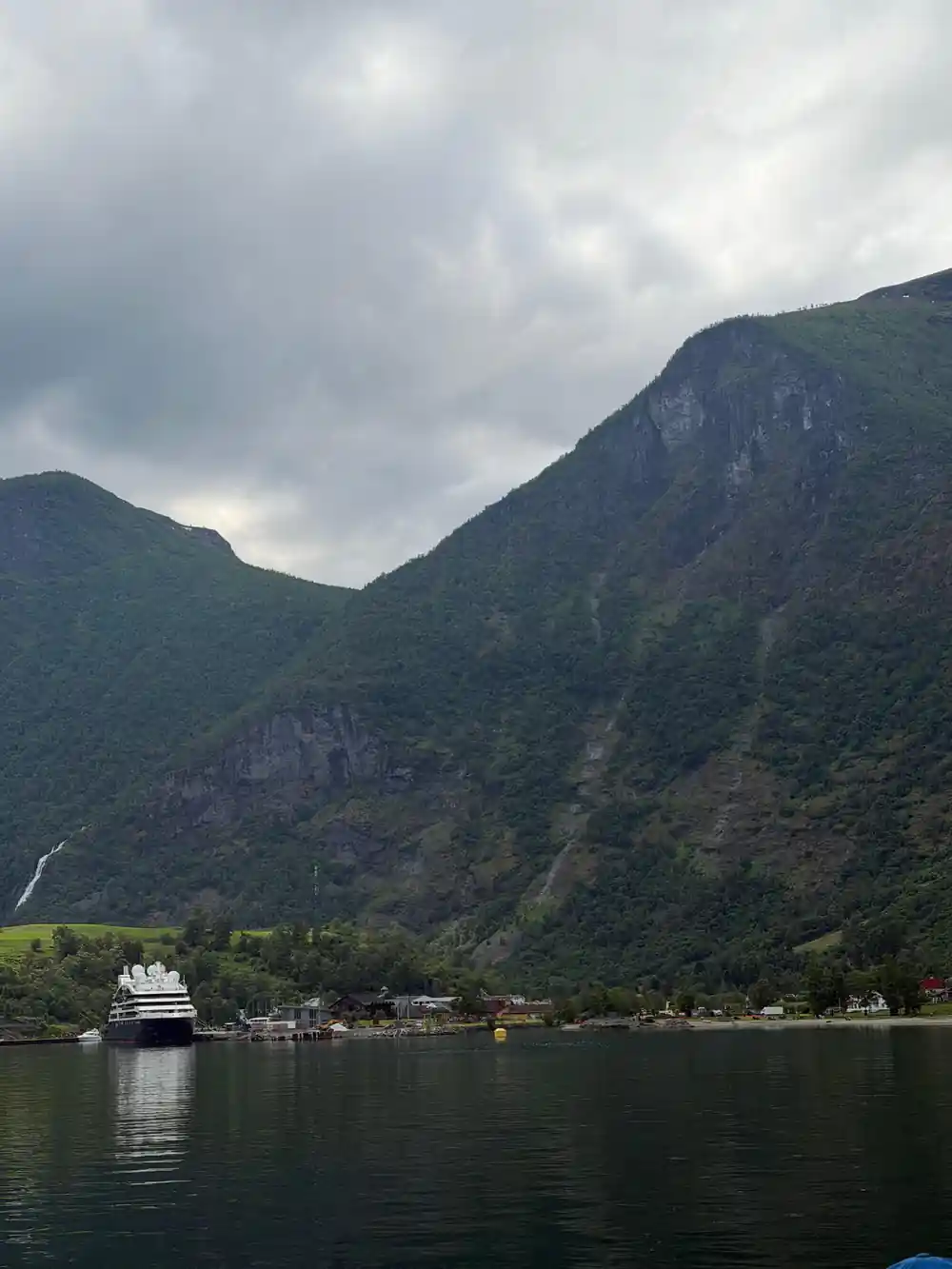
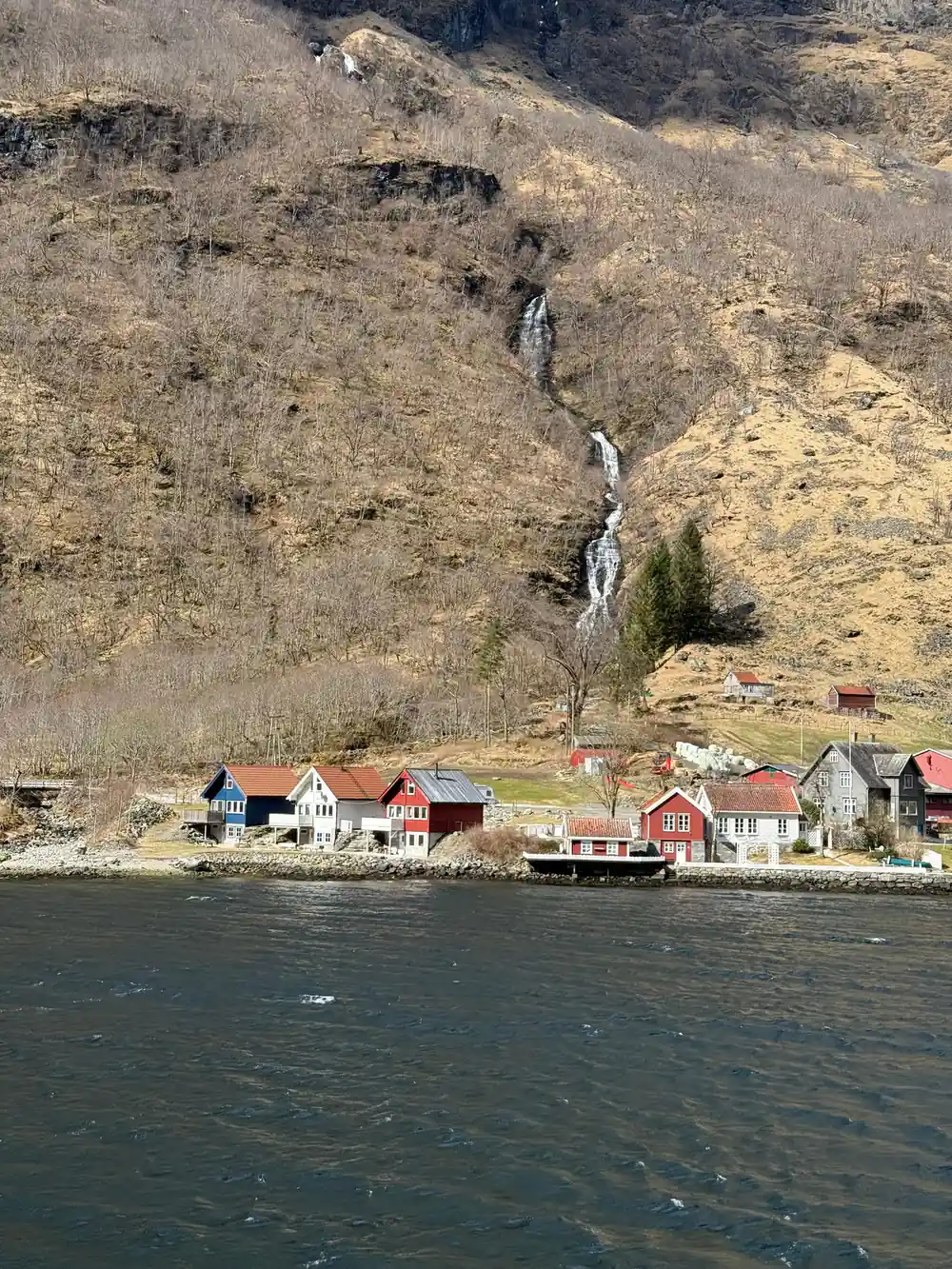
The Naeroyfjord from the deck, with waterfalls on both walls
When the boat sails, and how to plan around it
The Sognefjord express boat runs from April to October [1]. In that window there is one sailing a day in each direction: 08:00 from Bergen and 15:30 from Flam [1]. It departs from Strandkaiterminalen in Bergen [1], which is a short walk from the Bryggen side of the harbour and easy to find if you are staying centrally.
One sailing a day each way is the thing to plan around. There is no afternoon alternative from Bergen and no second chance from Flam. If you intend to use the boat as your transport in one direction, you are committing to that departure, and a missed 08:00 means waiting until the next morning. Book ahead in the high season rather than turning up at the terminal.
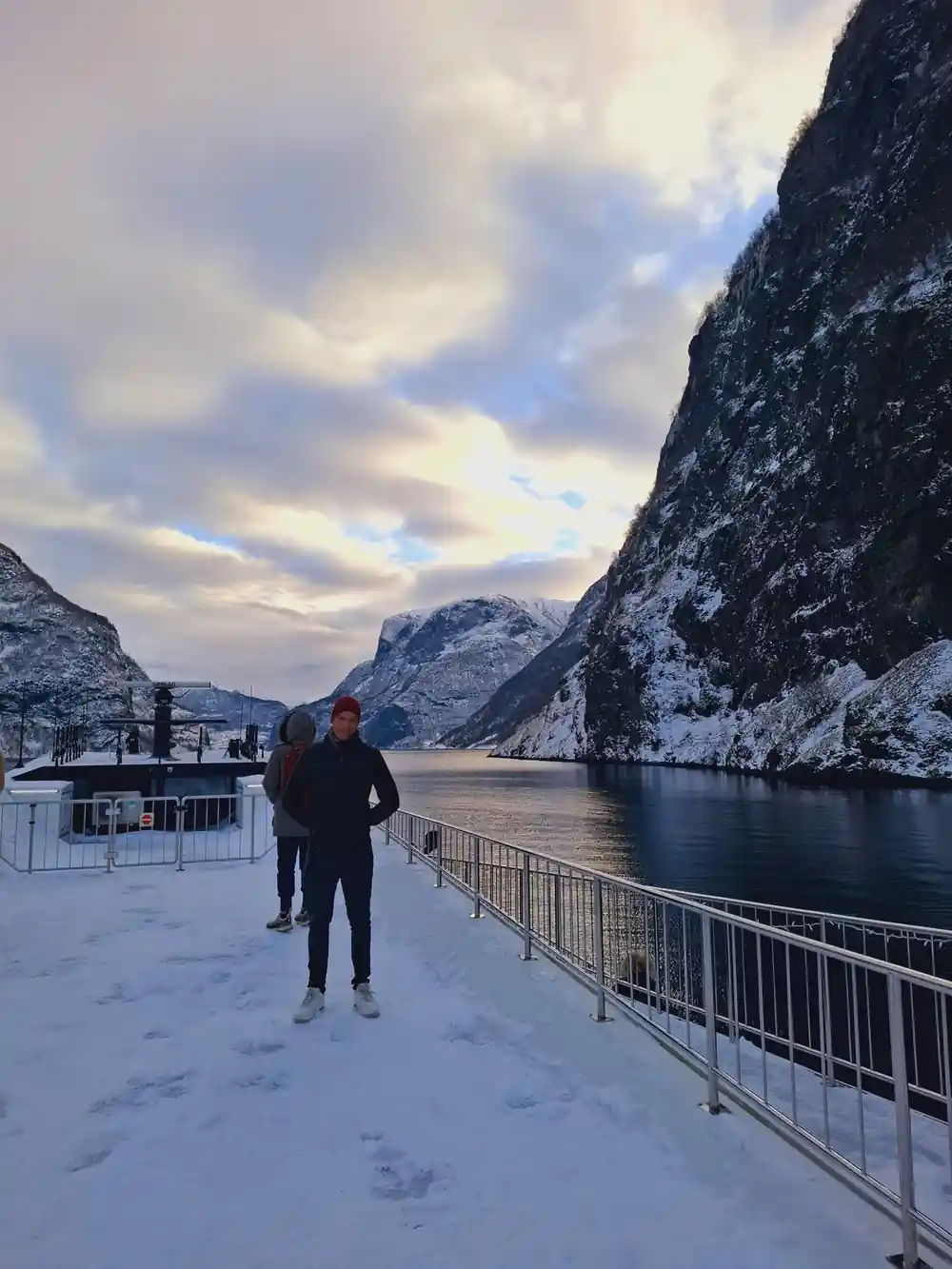
The season also decides whether the boat is an option at all. Outside April to October it is not running [1], which is worth knowing if you are visiting in winter and hoping to do the fjord by water. In the winter months the road and the rail are the only ways through.
The Viking Village, Nærøyfjord Cruise and Flåm Railway day
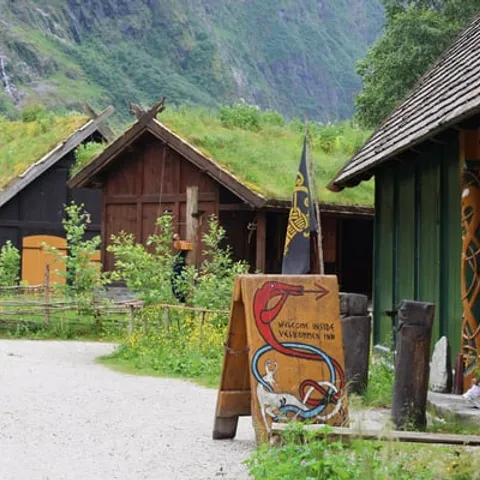
The Bergen: Viking Village, Nærøyfjord Cruise & Flåm Railway is a live guided day with commentary in English and Spanish. It combines the Flåm Railway, a Nærøyfjord cruise and the Viking Village, with stops at Voss, Flåm and Tvindefossen along the way. Reserve now and pay later, and cancellation is free.
So the water is already paid for. On this tour you do not buy a separate boat ticket, and the Nærøyfjord cruise is folded into the day along with the Flåm Railway, the Viking Village and the Tvindefossen stop.
Cancellation is free, and you can reserve now and pay later. Starting times are shown when you check availability, so the day can be planned around the express boat if you wish.
5.5 hours
The Norled Sognefjord express boat takes about 5.5 hours one way from Bergen to Flam, with one sailing a day each way from April to October [1].
Booking the boat yourself against booking the day
If you book the express boat yourself, you are buying a seat on a scheduled service and arranging everything around it: getting to Strandkaiterminalen for 08:00 [1], getting from Flam onward, and finding your own way back or paying for a night in the village. The fare is from 1,295 NOK per adult one way [1], so a same day return by boat is not possible on this timetable anyway, since the return sailing leaves Flam at 15:30 [1] and arrives back in Bergen in the evening.
The Bergen: Viking Village, Nærøyfjord Cruise & Flåm Railway solves that differently. It uses the coach and the Flåm Railway for the land legs and the boat for the Nærøyfjord section, and returns you to Bergen the same evening. For a single day trip that is the cleaner shape: one booking and one operator responsible for the whole loop.
Where the standalone boat wins is flexibility and independence. If you want to stay in Flam, walk the village, take the Flam Railway up to Myrdal the next morning and come back a different way, the express boat is a beautiful piece of that plan. It is transport with a view, not a tour, and it is priced like transport.
The Train via Myrdal as the comparison case
The rail option is Bergen to Myrdal on the Bergen Line, then a change to the Flam Railway for the Myrdal to Flam leg. Book a through ticket to Flam and the Flam Railway leg is included. Total time is about 2h48 to 4h30 depending on the connection at Myrdal, with roughly four departures a day [2].
Vy's cheap advance fare is called Lowfare, released up to 90 days ahead, tied to one departure, and not refundable or changeable [2]. It rises as seats sell, toward a walk-up fare several times higher [2]. Secondary sources quote Bergen to Flam from 779 NOK and from 810 NOK each way, but they measure different tickets, so check vy.no for the fare on your date rather than trusting either figure. The Flam Railway itself runs from 430 NOK low season to from 510 NOK high season one way, and from 620 NOK to from 730 NOK return, with high season mainly June to August spilling into May and September.
Against that, the train is faster to Flam and can undercut the boat if you book early and accept the fixed departure. Against that, from Bergen the rail line does not follow the fjord; it climbs inland. You get the dramatic Flam Railway descent at the end, not five and a half hours on the water. Different product, different pleasure, and the fare terms are much stricter than a boat ticket.
Getting to the boat, and the road alternative
The express boat leaves from Strandkaiterminalen in Bergen [1]. If you are not doing the guided day, that is your start point, and it is walkable from the centre. Express coaches to Flam run from 21 EUR, and Skyss city tickets are not valid on those coaches, though a Skyss single in Bergen is from 51 NOK and lasts 60 minutes. Do not assume a city ticket gets you to a long distance coach stop.
Driving is the other option and it is not a comparison column for a reason: it is a different kind of day. Bergen to Flam is about 166 km and about 2h32 by road [3], via the E16 to Voss and then road 7 into Flam [3]. Tolls for the route come to under 100 NOK [3]. If you take the Laerdal route, the Laerdal Tunnel is free, is the longest road tunnel in the world at 24.5 km, has an 80 km/h limit and no overtaking [3].
One warning if you are driving and considering that tunnel: from autumn 2026 to autumn 2028 the Laerdal Tunnel closes to traffic between 18:00 and 06:00 [3]. Plan the drive in daylight or take the other road. None of this affects the boat, which is unaffected by tunnel maintenance and runs its single daily sailing regardless.
The crossing against the alternatives
The boat is the slowest way to Flam and the only one that is itself the attraction.
What the crossing costs your party
Both are "from" prices. The guided day already carries a cruise ticket; the boat is bought on its own.
The sailing season
Plan the water leg
Decide boat or tour
If you want the express boat as transport, book Norled directly. If you want the fjord inside a single day from Bergen, take the Bergen: Viking Village, Nærøyfjord.
Check the sailing date
The express boat only runs April to October, one sailing a day each way, 08:00 from Bergen and 15:30 from Flam [1].
Book the boat early
One departure a day means full sailings in high season. Buy ahead rather than arriving at Strandkaiterminalen hoping for a seat [1].
Match the group to the fare
Adults from 1,295 NOK, children 6 to 17 and seniors 67 and over from 648 NOK, students 18 to 29 from 777 NOK, under 6 free [1].
Check the tunnel window
Driving instead? The Laerdal Tunnel closes 18:00 to 06:00 from autumn 2026 to autumn 2028, so plan daylight hours [3].
Arrive with time
Guests on the guided Viking Village day should check availability for starting times. Express boat passengers board at Strandkaiterminalen [1].
Viking Village, Nærøyfjord cruise and Flåm Railway in one day
from US$421